Our Topics

Our research spans multiple interconnected themes, among them Coastal Technology & AI, the Biological Carbon Pump, and Aquatic Productivity & Biodiversity. We develop and apply advanced underwater imaging systems and AI-based analysis to observe plankton communities and organic particles in unprecedented detail. By linking image data with biogeochemical measurements, we investigate how particulate organic carbon (POC) is transported through the ocean and shapes long-term carbon storage. At the same time, we study how plankton diversity and traits influence marine productivity and respond to environmental change. Together, these approaches provide an integrated understanding of the ocean’s role in the global carbon cycle and support the sustainable management of marine ecosystems.
Coastal Technology & AI
Underwater Imaging and AI to Decode the Biological Carbon Pump

Machine Learning Workflow for Image Analysis: Billions of underwater images of plankton and particles are annotated by experts and used to train convolutional neural networks (CNNs) for automated feature extraction and classification. This AI-based approach identifies species, traits, and particle characteristics, providing new insights into marine biodiversity and carbon cycle dynamics. (Image: Ankita Ravi Vaswani, Hereon)
The Biological Carbon Pump Department deploys state-of-the-art underwater imaging systems to observe billions of plankton organisms in their natural habitats with unprecedented spatial and temporal resolution. These methods enable continuous, non-invasive monitoring of plankton communities and organic particles that form the base of marine food webs. Combining imaging with AI-based analysis, we go beyond conventional taxonomic classification to identify functional traits such as life-cycle stages, feeding modes, and behaviors. Our trained convolutional neural networks (CNNs) detect complex biological patterns and interactions, uncovering new links between biodiversity, plankton traits, and environmental change. The resulting high-resolution data provide vital input for ecosystem models and global carbon flux estimates, improving predictions of the ocean’s role in climate regulation.
Our projects on this topic
Biological Carbon Pump
Observing Marine Snow and Carbon Flux

Particulate organic carbon sinks as marine snow into deeper ocean layers (Image: Klas Ove Möller, Hereon)
The biological carbon pump is a key mechanism by which the ocean captures and stores atmospheric carbon, helping to regulate Earth’s climate. Central to this process is particulate organic carbon (POC), which forms when carbon fixed by primary producers near the sea surface aggregates into organic particles known as marine snow. As these particles descend into deeper waters, carbon can be stored for centuries to millennia, making POC a crucial driver of long-term carbon sequestration.
To better understand this process, the Biological Carbon Pump Department combines traditional sampling with optical light-scattering measurements and high-resolution underwater imaging. By linking image-derived particle properties with measured POC data, we can estimate carbon fluxes directly from images and generate high-resolution time series offering new insights into the variability of carbon transport in coastal ecosystems.
Our projects on this topic
Aquatic Productivity and Biodiversity
The Ocean's hidden microcosmos: small bugs with a big impact
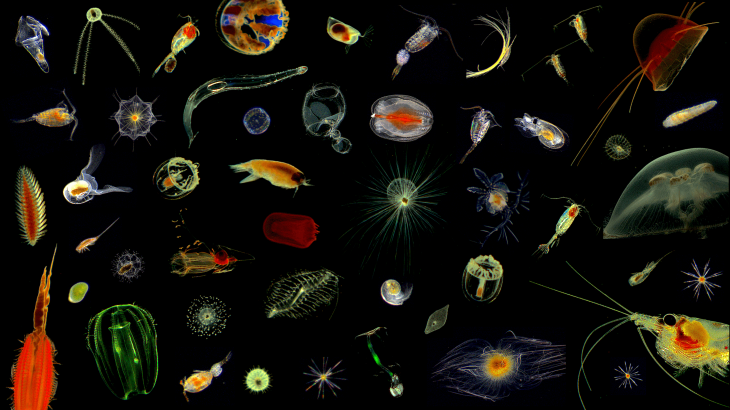
Plankton images captured in-situ in the Atlantic Ocean (Image: Klas Ove Möller, Hereon)
Plankton are tiny drifting microorganisms that are not only fascinating, colorful, and beautiful, but also of enormous importance. These organisms form the base of the marine food web, drive key biogeochemical cycles, and play a crucial role in regulating the global climate. Some species even perform the largest daily migration in the world.
Our research focuses on investigating the impact of these organisms on oceanic carbon fluxes, their biodiversity, and their responses to climate change—using and further developing high-resolution underwater imaging systems and AI-assisted analytical methods.