
Bridging the gap between in vitro and in vivo degradation rates for Mg-xGd implants
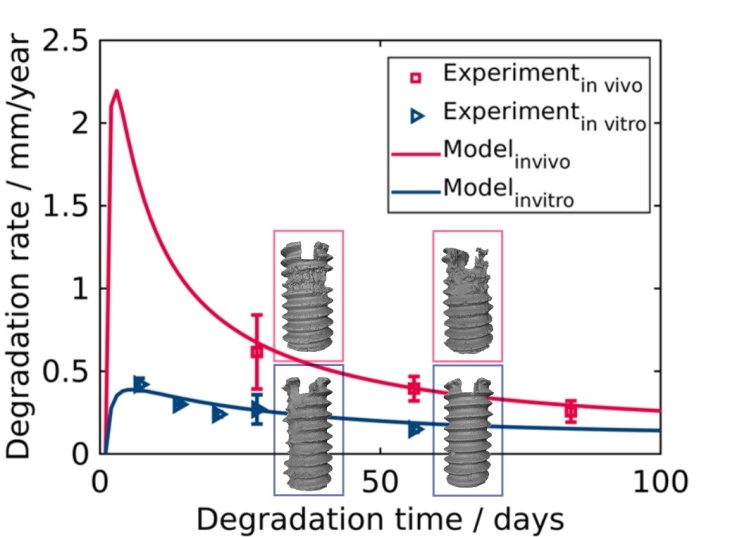
The degradation rate calculated using the surrogate model in comparison to the experimental data. Volume renderings are inserted for samples after 4 and 8 weeks of degradation
Figure: Hereon / Tamadur Al Baraghtheh
Is it possible to predict in vivo degradation of magnesium implants based on their in vitro degradation? In our recent publication “Utilizing Computational Modelling to Bridge the Gap between In Vitro and In Vivo Degradation Rates for Mg-xGd Implants”, we built a surrogate model that is trained on a more computationally expensive computer model. By calibrating the surrogate model to datasets from in vitro and in vivo degradation of magnesium-based screws, we have been able to find a parameter with which we can map one to the other. In this case, we can link the diffusion rates of Mg2+ ions in the different systems. In the future, it may become possible to estimate degradation rates in vivo by leveraging such links between diffusion rates derived from in vitro and in vivo experiments through surrogate models. This enables to draw conclusions about in vivo degradation rates solely from in vitro experiments. Al Baraghtheh et al., Corros. Mater. Degrad. 2023 4(2):274-283