
Progress in Application-Oriented Sintering Simulation
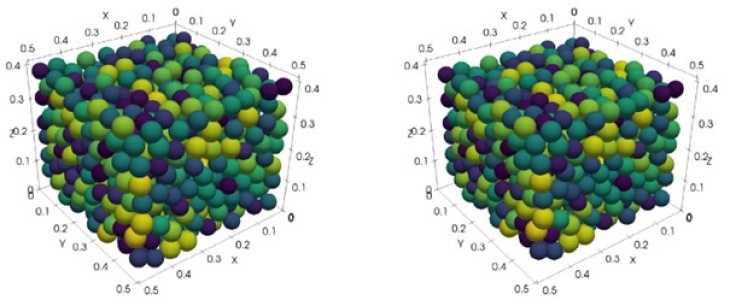
Simulation of the sintering of a powder cube. The new model realistically describes the coalescence of the powder particles, which leads to a change in the size of the cube (left: initial configuration, t = 0s, right: final configuration, t = 5000s)
Image: Hereon / Vladimir Ivannikov
Sintering is the central process in the manufacturing techniques used at the institute to produce a solid, ready-to-use implant from loose metal powders. The powder particles grow together at high temperatures and an almost dense material is created. The alloy, powder form, powder size, temperature and time play a critical role in the properties of the final implant. Today, even in industry, optimized process parameters are often determined in complex test series that cost time and money. There is therefore great interest in using computer simulations to reduce this effort and calculate optimum sintering parameters to achieve the desired implant properties without the need for experimental test series.
Together with the Institute for Material Systems Modeling, such an application-oriented sintering model is being developed. In a recent study, a decisive step was taken to perform physically accurate calculations in an acceptable computing time. In particular, a problem inherent in many existing sintering models was eliminated, namely that the component does not shrink in the simulations, which it does in reality. A new approach combines a “7DOF” (7 degrees of freedom) model developed at Hereon with a discrete element method model. While the former calculates the material movements between the various powder particles with little computational effort, the latter models the forces that occur and the associated change in shape. Comparisons with experimental data showed good agreement.
Ivannikov et al., Comp. Part. Mech. 2023 10:185–207