Hereon awarded
Researchers at the Helmholtz-Zentrum Hereon are regularly honored with awards. Dr Sven Berger from the Hereon Institute of Surface Science has received the Helmholtz Software Award for the software TrixiParticles.jl. Whether in climate, coastal, or materials research, our scientists are regularly nominated for prizes or win them outright. Like all employees, they bring the slogan “Cutting-edge research for a changing world” to life. Here, Hereon presents the award winners and their research topics.
Dr Sven Berger, Hereon Institute of Surface Science

Sven Berger (r.) and Sebastian Schmidt, Vice President of Helmholtz-Gemeinschaft, at the Awards Ceremony at Helmholtz-Zentrum Dresden-Rossendorf (HZDR). Photo: Kalina Zheynoval/HZDR
TrixiParticles.jl was honored with the Helmholtz Software Award. The award recognizes the work of our Hereon researcher Dr. Sven Berger, who collaborated on this project with Erik Faulhaber (University of Cologne) and Niklas Neher (University of Stuttgart, HLRS - High-Performance Computing Center Stuttgart).
TrixiParticles.jl is a Julia-based open-source software that enables the simulation of complex physical processes. This also supports Hereon’s research, for example in the simulation of water flows or in structural mechanics, and is equally useful in coastal research and materials development. The work combines scientific excellence with high computing power.

Simulation with TrixiParticles.jl. Source: Sven Berger
The award recognizes scientific software that is an integral part of research and researchers’ work. Sven Berger says: “For us, the award is both recognition of our work and an incentive. I hope that our software will now become better known and that this will lead to new collaborations and further scientific applications.” TrixiParticles.jl on Github
Dr Prokopios Georgopanos and Dr Lucas Merckelbach, Hereon Institute of Membrane Research and Hereon Institute of Coastal Ocean Dynamics

Presentation of the F. Laeisz Award for Maritime Innovation: Dr Lucas Merckelbach and Dr Prokopios Georgopanos; Katharina Fegebank, Hamburg Senator for Science, Research, Equalities and Districts and Second Mayor of Hamburg; Prof Laura Marie Edinger-Schons, Chief Sustainability Officer and Professor of Sustainable Business, University of Hamburg; Prof Jetta Frost, Vice President of the University of Hamburg; and Ute Schües, Head of Sustainability, F. Laeisz GmbH (from left to right). Photo: Hereon/Volker Abetz
Dr Prokopios Georgopanos and Dr Lucas Merckelbach are delighted: they have been awarded the inaugural F. Laeisz Award for Maritime Innovation for the development of an innovative underwater energy system. The technology is designed for applications such as ocean gliders and other autonomous underwater vehicles. The system is based on a hydrogen fuel cell. Its key innovation is a membrane module that functions like artificial gills, extracting oxygen directly from seawater and thereby enabling the energy-efficient operation of the vehicles.
The colleagues received the first prize, which was endowed with € 10,000. With this award, the University of Hamburg and F. Laeisz GmbH recognize scientific and practice-oriented projects, initiatives, and start-ups that make a demonstrable contribution to the sustainable transformation of the maritime economy. In addition to the first prize, a second and a third prize were also awarded.
F. Laeisz Award for Maritime Innovation
Fabian Kirchner and Catriona Eschke, Hereon Institute of Metallic Biomaterials

Fabian Kirchner (left) at the presentation of the Best Demonstrator Award. Photo: BAM
At the end of last year, Fabian Kirchner and Catriona Eschke were honored at the General Assembly of the MaterialDigital initiative with the Best Demonstrator Award for their outstanding contribution to digital materials research. Nine interactive software tools were presented as socalled demonstrators, which attendees could try out on site.
The award went to the demonstrator of the semantic electronic lab notebook Herbie, developed and presented by Kirchner and Eschke from the Institute of Metallic Biomaterials under the leadership of Prof WillumeitRömer. Herbie clearly demonstrates how digital methods can improve the recording and analysis of materials science experiments, thereby increasing transparency and reproducibility. The MaterialDigital initiative is working on the systematical digitalisation and interconnection of data, models, and workflows in materials science. The award recognizes the important contribution that Herbie makes to this effort.
More information about the MaterialDigital initiative
Prof Francesca Toma, Head of Hereon’s Institute of Functional Materials for Sustainability

Prof Francesca Toma was honored in the ACS Energy Letters as an outstanding scientist in energy research. Photo: Hereon/Sascha Kilmer
The ACS Energy Letters series Women Scientists at the Forefront of Energy Research: Part 8 focuses on distinguished women in energy research. Hereon Institute Director Prof Francesca Toma at the campus in Teltow is honored among other outstanding female scientists, all of whom published groundbreaking work in 2025. In the series, the researchers talk also about their life journeys and the challenges they faced along the way. They discuss how they became prominent figures in the scientific community. The aim is to motivate young women to take on the challenges and solutions for a sustainable future.
In her personal reflection, Francesca Toma says: "Ever since school, I have loved conducting experiments and remember afternoons in the school lab exploring the world through simple reactions and physical laws. This curiosity turned into a passion—and ultimately a commitment to developing materials and processes that protect our environment. I see this as an urgent scientific challenge and a debt owed to future generations. And I feel privileged to be working with young researchers toward a greener future."
More information about the ACS Letters
Dr Gaoming Zhu, Hereon Institute of Material and Process Design

Dr Gaoming Zhu is delighted to receive the "International Magnesium Science & Technology Award for Youth of the Year". Photo: Juan José Trujillo Tadeo
The International Magnesium Science & Technology Award for Youth of the Year is presented annually by the International Magnesium Society (IMS) and the Journal of Magnesium and Alloys (JMA). It honors young researchers who advance work on magnesium and its alloys, recognizing contributions that are both scientifically excellent and relevant for industrial applications. Dr Gaoming Zhu from the Hereon Institute of Material and Process Design has now received this prestigious award. Zhu is a leading early-career researcher in the field of magnesium materials and focuses on improving the mechanical properties of magnesium alloys, which are considered ultra-lightweight materials of great importance for the automotive, aerospace, and medical technology sectors.
His work combines experimental methods such as special synchrotron three-dimensional X-ray diffraction (3DXRD) and imaging with computational models and machine-learning approaches to understand the deformation mechanisms of magnesium. These studies contribute to fundamental research and have a direct impact on industrial manufacturing by enabling the production of magnesium components with high performance and improved sustainability.
More information about the International Mg Society
Dr Louis Celliers, Climate Service Center Germany (GERICS)

Dr Louis Celliers, keynote speaker, received the “Fellow Membership of the Western Indian Ocean Marine Science Association”. Photo: WIOMSA
In October 2025, Dr Louis Celliers attended the 13th Western Indian Ocean Marine Science Symposium, which recorded a record attendance of around 1,200 participants. In addition to his workshops and scientific contributions, he was invited to deliver a keynote address. He was also awarded 2025 Fellow Membership of the Western Indian Ocean Marine Science Association (WIOMSA). This distinction is granted only every three years to scientists who have made outstanding contributions or significant advances in coastal and marine science research in the Western Indian Ocean region.
The award is particularly meaningful for Celliers, as he began his scientific career in the Western Indian Ocean region and continues to maintain strong collaborations and networks there. He is currently leading a project in the region, and many of his publications are based on work conducted there—also in connection with his research at GERICS.
More information about WIOMSA
Dr Bahram Vaghefinazari, Hereon Institute of Surface Science
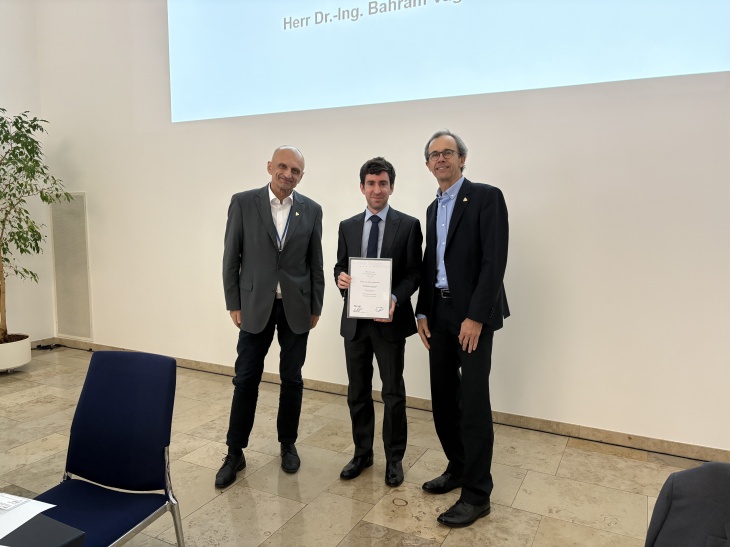
Dr. Bahram Vaghefinazari (middle) received the “Dr. Klaus Seppeler Foundation Award.” Photo: Roman Bender
Dr Bahram Vaghefinazari recently received the Dr. Klaus Seppeler Foundation Prize, which honors outstanding early-career researchers in the field of corrosion and corrosion protection. Vaghefinazari was recognized for his significant scientific contributions presented in his doctoral thesis. His research focuses on developing advanced strategies for corrosion protection of magnesium alloys. Particularly through the use of PEO coatings (an electrochemical surface treatment technique) loaded with corrosion inhibitors that significantly reduce the corrosion rate of metals. This is a highly relevant topic for lightweight engineering and biomedical implant technology.
The award ceremony took place in Frankfurt during the 30th General Assembly of the Society for Corrosion Protection (gfkorr e.V.), bringing together leading experts in corrosion science and representatives of the Seppeler Foundation. This distinction highlights the excellent research conducted at Hereon in the field of corrosion science and surface engineering, while also acknowledging the outstanding guidance provided by his scientific mentors, Prof Mikhail Zheludkevich and Dr Sviatlana Lamaka.
More information about the Society for Corrosion Protection (gfkorr e.V.)